Crypto Token Burning Explained: Why Are Projects Destroying Millions of Coins, and Can It Make You Rich?
Crypto token burning is one of the most talked-about mechanisms in the cryptocurrency industry. From major blockchain networks to emerging altcoin projects, developers regularly announce token burns, sometimes involving millions or even billions of tokens.
These announcements often attract attention from investors. Some see a token burn as a positive signal because fewer tokens may remain available in the market. Others believe it could create scarcity and potentially support long-term value.
But there is an important question that every crypto investor should ask: Does destroying cryptocurrency actually make the remaining tokens more valuable?
The answer is not as simple as many headlines suggest.
Token burning can influence a cryptocurrency's supply dynamics, but it does not guarantee higher prices. Market demand, investor confidence, real-world utility, and broader market conditions continue to play a major role.
Let's understand how crypto token burning works, why projects use it, and what investors should look at before getting excited about a burn announcement.
What Exactly Is Cryptocurrency Token Burning?
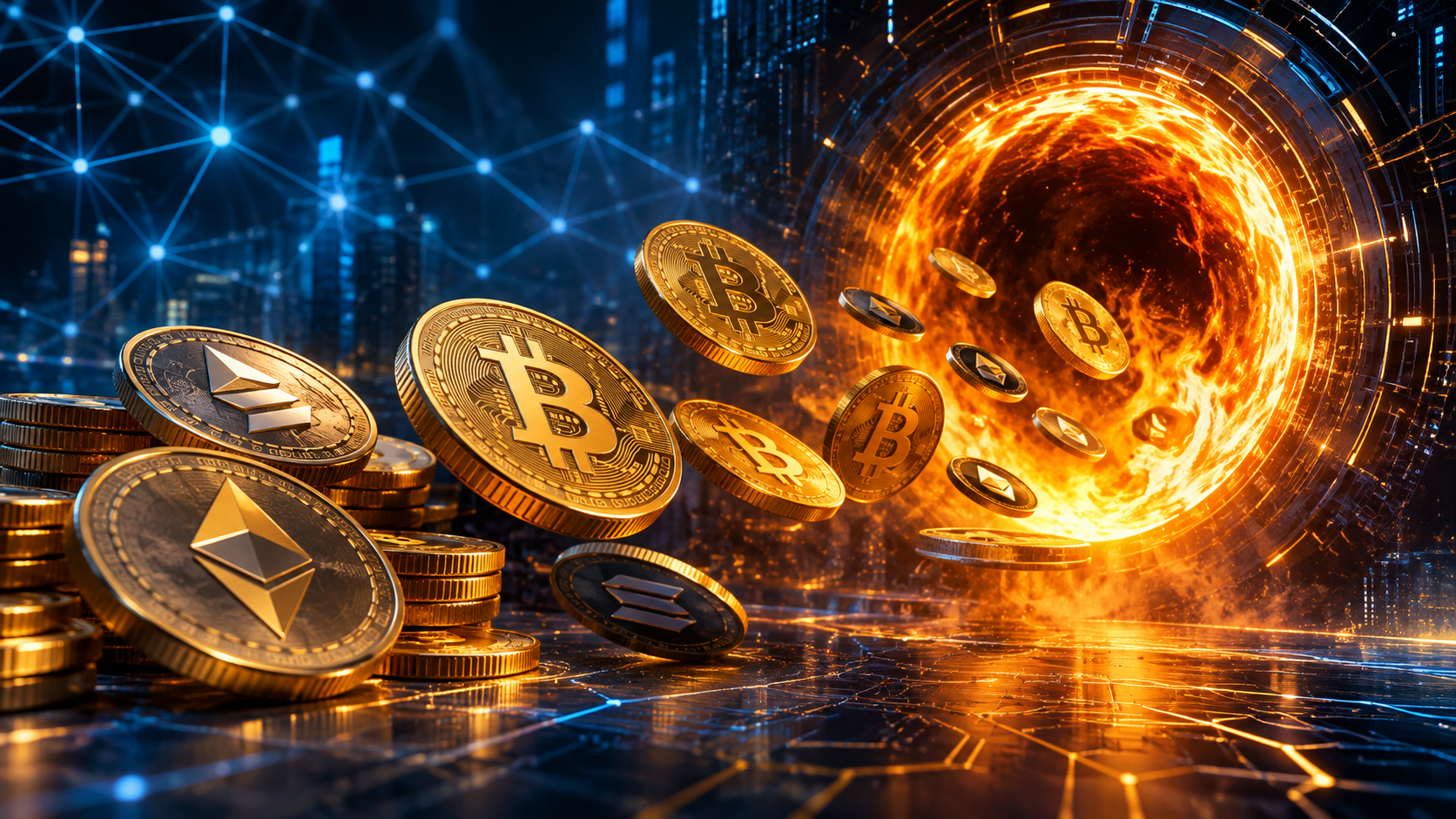
Token burning refers to the permanent removal of cryptocurrency tokens from circulation.
In simple terms, imagine a cryptocurrency project has 1 billion tokens in existence. Its development team decides to permanently remove 100 million tokens from the available supply.
After a properly executed burn, those tokens can no longer be used, transferred, or traded. The remaining supply would be 900 million tokens, assuming the burn actually reduces the total token supply.
This process is generally carried out by sending tokens to a special blockchain address known as a burn address or an inaccessible address.
Such addresses are designed so that nobody can spend the tokens sent to them.
Unlike ordinary cryptocurrency transfers, a genuine burn is intended to permanently remove tokens from use.
The transaction can usually be verified through the blockchain, allowing investors to check whether the announced burn actually happened.
Why Do Cryptocurrency Projects Burn Their Tokens?
Token burning is not simply about destroying digital assets. Projects may use it as part of their broader tokenomics strategy.
There are several reasons behind this mechanism.
1. Reducing the Available Token Supply
One of the main reasons for burning tokens is to reduce the number of tokens available in circulation.
When a project permanently removes tokens, the circulating supply may decrease.
For example, if a cryptocurrency has 500 million circulating tokens and 50 million are genuinely removed from circulation, the circulating supply could fall to 450 million.
However, investors should distinguish between circulating supply and total supply. A burn of tokens that were already locked, reserved, or excluded from circulation may have a different economic impact from burning actively circulating tokens.
2. Creating a Scarcity Mechanism
Some blockchain projects use token burns to introduce scarcity into their economic models.
The idea is relatively straightforward: if demand remains strong while the available supply decreases, the remaining tokens could become more attractive to buyers.
Bitcoin is often discussed in conversations about scarcity because its maximum supply is limited to 21 million BTC.
However, a fixed supply and a token-burning mechanism are not the same thing.
A project that burns tokens may still have mechanisms that allow new tokens to be issued. Investors therefore need to examine the complete supply policy rather than focusing on a single burn announcement.
3. Supporting a Long-Term Tokenomics Strategy
Token burning can also be part of a project's long-term economic design.
Some networks connect token burns to transaction activity, protocol fees, or other ecosystem operations.
In these models, the amount burned may depend on how actively people use the network.
This creates a connection between blockchain activity and token supply management.
However, whether such a mechanism benefits token holders depends on how the system is designed and whether the network attracts sustainable usage.
4. Demonstrating Commitment to the Ecosystem
A token burn announcement can also communicate a project's economic strategy to its community.
For example, a development team might decide to burn a portion of its token allocation rather than keep those tokens in its treasury.
Such a decision may influence investor perception, especially when the burn is transparent and independently verifiable.
Still, a token burn should never be treated as proof that a project is financially healthy or has a successful future.
How Does a Token Burn Actually Work?
The process is generally straightforward, although the technical implementation depends on the blockchain.
Here is how a typical token burn happens:
Step 1: The project identifies the tokens to be burned.
A blockchain project determines how many tokens it intends to remove from circulation.
Step 2: Tokens are sent to a burn address.
The tokens are transferred to an address designed to make them permanently inaccessible.
Step 3: The blockchain records the transaction.
The transaction becomes visible on the relevant blockchain explorer, allowing anyone to verify the transfer.
Step 4: The supply figures are updated.
Depending on the token's design and the burn method, the circulating or total supply figures may be adjusted.
Transparency is important here. Investors should be able to independently verify the transaction rather than relying entirely on a project's social media announcement.
Does Burning Tokens Automatically Increase Their Price?
This is where many cryptocurrency investors misunderstand the concept.
A token burn does not automatically create a price increase.
Consider a hypothetical cryptocurrency with a circulating supply of 1 billion tokens and a market price of $1.
Its market capitalization would be approximately $1 billion.
Now imagine the project burns 100 million tokens.
If the market price remains unchanged, the circulating supply reduction does not automatically create a higher market capitalization or additional investor demand.
For the remaining tokens to become more valuable, market participants must be willing to pay more for them.
That depends on several factors:
- Demand: Are more people interested in buying the cryptocurrency?
- Utility: Does the token have a meaningful purpose within its ecosystem?
- Adoption: Are businesses, developers, and users actually using the network?
- Investor confidence: Do market participants believe the project has long-term potential?
- Market conditions: Is the broader cryptocurrency market experiencing growth or a downturn?
A project could burn millions of tokens and still experience a price decline if investors lose confidence or demand weakens.
On the other hand, a token with genuine utility and growing adoption may attract buyers even without a major burn announcement.
Real-World Examples of Cryptocurrency Token Burning
Several established blockchain ecosystems have incorporated token-burning mechanisms into their economic models.
Ethereum: Burning Transaction Fees
Ethereum introduced a major change to its fee structure through the EIP-1559 upgrade in August 2021.
Under this mechanism, the base fee paid for transactions is burned rather than transferred to validators.
This means Ethereum's supply can decrease during periods when the amount of ETH burned exceeds newly issued ETH.
However, Ethereum is not permanently deflationary under every market condition. Its net supply depends on both issuance and the amount of ETH burned.
This makes network activity an important factor in understanding Ethereum's supply dynamics.
BNB: An Automated Token-Burning Mechanism
BNB has also used token-burning mechanisms as part of its supply-management strategy.
Its Auto-Burn system determines the amount of BNB to be burned using a formula that considers factors including BNB's price and the number of blocks produced on BNB Chain during a particular period.
BNB also has a real-time burning mechanism associated with certain transaction fees.
These mechanisms are designed to move the token toward its stated long-term supply target.
Shiba Inu: Community-Driven Token Burns
Shiba Inu has attracted significant attention because of its community-driven token-burning initiatives.
Members of the ecosystem have participated in different initiatives designed to remove SHIB tokens from circulation.
However, the size of a burn announcement should always be considered relative to the token's overall supply.
Burning millions of tokens may sound impressive, but the economic impact can be limited when the total supply is extremely large.
These examples demonstrate that token burning is not a single standardized mechanism. Different blockchain projects implement it in different ways.
What Should Investors Check Before Buying a Token After a Burn?
A token burn announcement can create excitement, but investors should look beyond the headline.
Here are five important things to examine.
1. Check the actual number of tokens burned.
Look at the blockchain transaction and verify whether the announced tokens were genuinely removed.
2. Compare the burn with the total supply.
A burn involving 10 million tokens might sound significant, but its importance depends on the cryptocurrency's overall supply.
3. Understand where the burned tokens came from.
Were they taken from circulating supply, an unlocked treasury allocation, or tokens that were already inaccessible?
This distinction matters when evaluating the economic impact.
4. Examine the project's real utility.
A cryptocurrency needs a reason for people to hold, use, or acquire it. Token burning alone cannot create sustainable demand.
5. Watch what happens after the announcement.
Sometimes the market reacts before the actual burn takes place. Investors should avoid assuming that every burn announcement will lead to a lasting price increase.
Can a Cryptocurrency Become Deflationary Through Token Burning?
Yes, a cryptocurrency can become deflationary if its token-burning activity consistently exceeds the number of new tokens entering circulation.
However, the distinction between a token being burned and a cryptocurrency having a deflationary supply is important.
For example, suppose a blockchain issues 10 million new tokens during a particular period but burns 15 million tokens.
Its net supply would decrease by 5 million tokens during that period.
If the network instead issues 20 million tokens and burns 15 million, its net supply would increase by 5 million.
This is why investors should monitor both token issuance and token burning.
A burn mechanism alone does not guarantee that the overall supply will keep falling.
The Bigger Picture: Token Burning Is Only One Part of Crypto Economics
The cryptocurrency industry continues to experiment with different ways of managing token supply.
Some projects use automatic burns, others rely on governance decisions, and some connect burning mechanisms directly to network transaction fees.
These approaches can influence how a cryptocurrency's economic model works.
But investors should remember that a smaller supply does not automatically mean a more valuable asset.
A cryptocurrency with limited supply but little demand may struggle to attract buyers. Meanwhile, a project with strong adoption, useful technology, and growing ecosystem activity may have stronger fundamentals.
The real question is not simply how many tokens a project has burned.
It is whether people have a compelling reason to use and hold the tokens that remain.
Frequently Asked Questions
What does token burning mean in cryptocurrency?
Token burning means permanently removing cryptocurrency tokens from circulation, usually by sending them to an inaccessible blockchain address.
Does token burning increase cryptocurrency prices?
Not necessarily. A burn may reduce supply, but price movements also depend on demand, utility, adoption, investor confidence, and broader market conditions.
Can burned cryptocurrency tokens be recovered?
In a properly implemented burn, tokens sent to an inaccessible address cannot be recovered or spent.
Why do crypto projects burn millions of tokens?
Projects may burn tokens to manage supply, implement tokenomics strategies, connect network activity with supply reduction, or demonstrate their long-term economic approach.
Which cryptocurrencies use token-burning mechanisms?
Ethereum, BNB, and Shiba Inu are notable examples of cryptocurrency ecosystems that have incorporated different types of token-burning mechanisms.
Is token burning good for crypto investors?
It can be a positive feature of a token's economic design, but it should not be the only reason to invest. Investors should examine supply, demand, utility, adoption, and project fundamentals.
Final Thoughts
Token burning has become an important part of cryptocurrency economics, but it is often misunderstood.
Removing tokens from circulation can change a cryptocurrency's supply dynamics. What happens to its market price, however, depends on much more than the number of tokens destroyed.
For investors, understanding the difference between reduced supply and genuine market demand is essential.
The next time a crypto project announces that it has burned millions of tokens, look beyond the headline. Check the numbers, understand the mechanism, and examine whether the project is building something people actually want to use.
About CoinAINews
CoinAINews Editorial Team covers cryptocurrency regulation, blockchain technology, digital asset markets, traditional finance, and developments shaping the global tech industry.
Disclaimer: This article is for informational and educational purposes only and should not be considered financial or investment advice.