
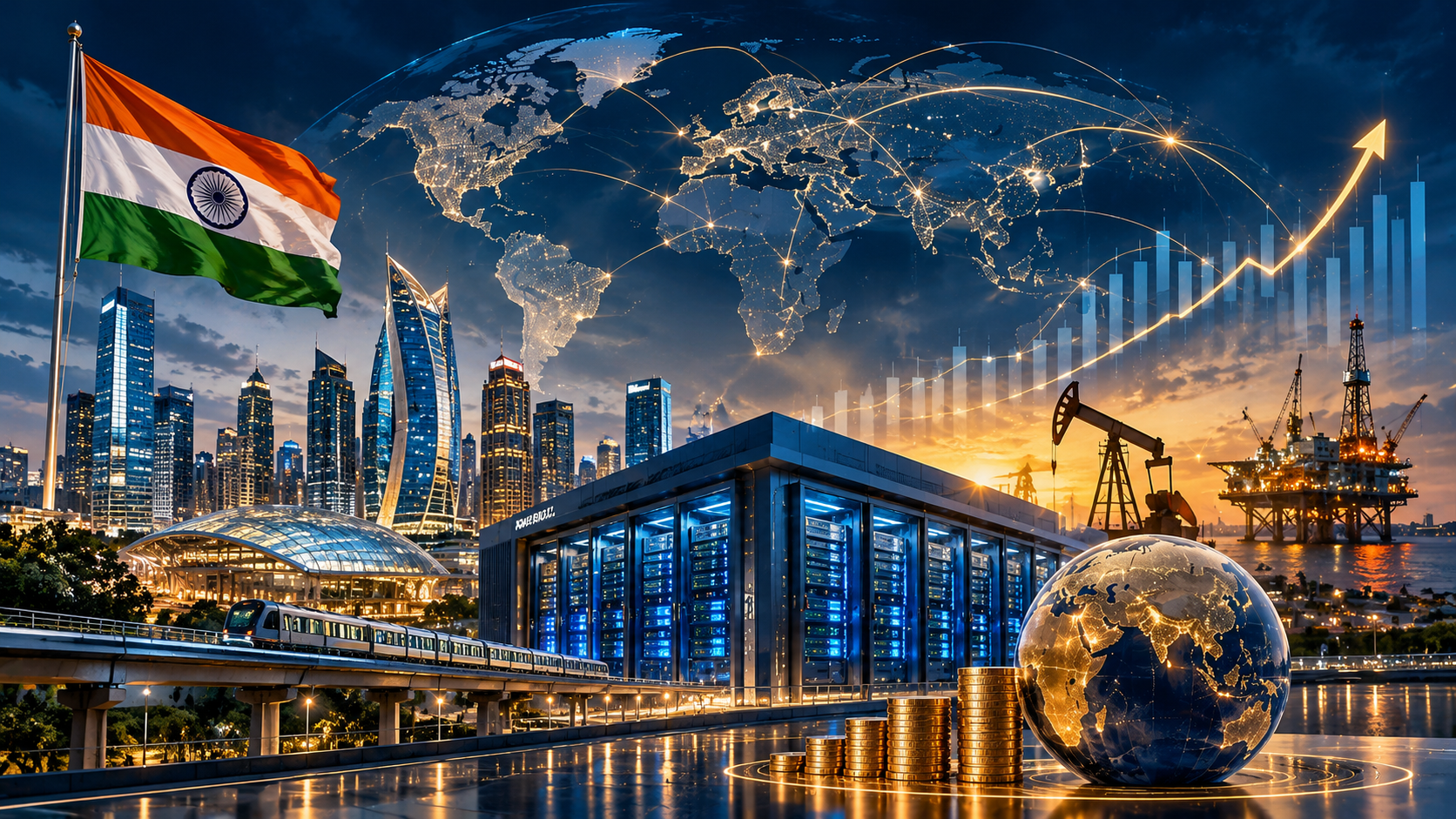
India Could Outgrow China in 2027 as $1.8 Trillion AI Boom and Cheaper Oil Reshape the Global Economy
The global economy may be heading into 2027 with a different set of growth drivers, and India is emerging as one of the major economies to watch.
Goldman Sachs Research expects global economic growth to reach 2.8% in 2027, slightly above its estimated 2.7% expansion in 2026. But the more striking part of its outlook is the gap between the expected growth rates of major economies.
India is projected to grow by 7.2% in 2027, compared with an estimated 4.5% for China and 2.4% for the United States.
At the same time, the investment bank expects global spending on artificial intelligence to climb to $1.8 trillion next year, while lower energy prices could provide additional support to economic activity.
Together, these forecasts point to three forces that could influence the global economy in 2027: India's economic momentum, the expansion of AI investment and a possible easing of energy costs.
India Could Maintain Its Lead Over China
India's projected growth rate is one of the most notable figures in Goldman Sachs' latest economic outlook.
The bank expects the Indian economy to expand by 7.2% in 2027, compared with an estimated 7.9% in 2026. Although this represents a moderation, the forecast remains above the market consensus estimate of 6.8%.
China, meanwhile, is projected to record 4.5% growth in 2027.
The comparison suggests that India could continue expanding at a considerably faster pace than its major Asian rival.
However, faster GDP growth does not mean India has overtaken China in the overall size of its economy. The two countries have very different economic structures, population sizes, industrial bases and income levels.
The more important takeaway is that India could remain among the fastest-growing major economies even as global financial conditions remain challenging.
For international investors and businesses, that could keep India firmly on the radar when evaluating future opportunities in manufacturing, infrastructure, technology and consumer markets.
Cheaper Oil Could Give the Global Economy Some Relief
Energy prices are another major part of the 2027 outlook.
Goldman Sachs commodity strategists expect Brent crude oil prices to decline to around $78 per barrel by the end of 2027, assuming Middle East supply conditions continue to adjust.
That would represent a change from the pressure that higher energy costs placed on economic activity during 2026.
Lower oil prices can support growth by reducing fuel and transportation costs, easing pressure on businesses and potentially helping countries that depend heavily on imported energy.
India is particularly exposed to changes in international crude prices because it imports a substantial share of the oil it consumes.
If global oil prices move lower, the country's import bill could receive some relief. Lower energy costs may also help reduce inflationary pressure and improve the operating environment for industries that depend on fuel and transportation.
But there is an important qualification: a decline in international crude prices does not automatically guarantee cheaper petrol or diesel for consumers. Currency movements, domestic taxes, refining margins and government pricing decisions also influence retail fuel prices.
Goldman Sachs' projection is therefore an economic outlook, not a promise that fuel prices will fall by a particular amount.
The $1.8 Trillion AI Investment Wave
Artificial intelligence could become one of the biggest engines of investment growth in 2027.
Goldman Sachs Research estimates that global nominal AI investment could increase from approximately $1.1 trillion in 2026 to $1.8 trillion in 2027.
That is an enormous amount of capital flowing into an industry that is already reshaping technology, business operations and financial markets.
Much of the expected increase is linked to hardware spending in the United States. Goldman Sachs expects US hardware investment to rise by more than $500 billion.
The spending is likely to support demand across several interconnected industries, including:
- Advanced semiconductors and AI processors.
- Data centres and cloud computing infrastructure.
- High-performance servers and networking equipment.
- Electricity generation, power systems and cooling infrastructure.
- Software platforms and AI-related services.
The investment bank estimates that AI spending could add approximately 0.4 percentage points to global GDP growth in 2027.
For the United States, the estimated contribution to underlying GDP growth is around 0.6 percentage points when adjustments for certain semiconductor investments and related intellectual property exports are considered.
This highlights how AI is becoming more than a technology-sector story. Its expansion is increasingly connected to construction, energy, manufacturing, trade and capital expenditure.
Why AI Spending Matters Beyond Big Technology Companies
The next phase of AI development will require much more than new software applications.
Large AI models need powerful computing systems, specialised chips, reliable electricity and extensive data-centre infrastructure.
That creates opportunities for companies operating throughout the technology supply chain.
Semiconductor manufacturers may benefit from demand for advanced processors. Data-centre operators need more computing capacity. Energy companies face growing demand from power-intensive facilities, while equipment manufacturers supply cooling, networking and electrical infrastructure.
The effects can also extend to countries that export electronics and technology components.
Goldman Sachs expects South Korea and Taiwan to benefit from continued strength in AI-related exports.
For investors, this means the AI opportunity is not limited to the companies developing chatbots or selling AI subscriptions. A substantial part of the investment cycle may be captured by the businesses building the infrastructure that makes large-scale AI possible.
However, the projected spending boom is not guaranteed. Goldman Sachs also warns that weaker demand, infrastructure constraints, regulation or financial-market stress could slow investment.
How the United States and Other Major Economies Compare
Goldman Sachs expects several developed economies to perform differently in 2027.
The United States is forecast to grow by 2.4%, up from an estimated 2.3% in 2026. Japan and the United Kingdom are also expected to grow faster than consensus forecasts.
China's projected 4.5% expansion would remain stronger than the US growth rate, although below India's expected pace.
The outlook for China also reflects some structural challenges. Goldman Sachs expects exports to provide support, but weak domestic consumption and continued problems in the property sector could constrain broader economic activity.
Meanwhile, South Korea and Taiwan may receive support from demand for AI-related exports.
These differences suggest that the next year may not produce a uniform global recovery. Countries with stronger domestic demand, competitive export industries or exposure to growing technology investment could have different growth experiences.
Inflation and Interest Rates Could Still Complicate the Outlook
Lower energy prices could help ease inflation, but the path will depend on how global supply conditions develop.
Goldman Sachs expects inflation pressures to moderate as energy prices normalise. In the United States, its economists forecast core personal consumption expenditures inflation to decline to 2.4% by the end of 2027, from 3.2% at the end of 2026.
That could eventually create room for central banks to move towards less restrictive monetary policy.
However, the bank expects further monetary tightening in several major economies early in 2027 before the possibility of policy easing later in the year.
For businesses and investors, the timing will matter. Higher borrowing costs can make large infrastructure projects more expensive, while lower inflation could gradually improve financial conditions.
The outlook therefore remains dependent on both economic growth and the direction of central-bank policy.
Three Major Risks Could Change the 2027 Forecast
Despite the relatively positive growth projections, Goldman Sachs warns that the risks to its global outlook are tilted to the downside.
1. Renewed Middle East tensions
A fresh escalation in the Iran conflict could disrupt energy supplies and push oil prices higher. That would weaken one of the key assumptions behind the expected improvement in global growth.
2. Government debt and fiscal pressure
Large fiscal deficits could push long-term borrowing costs higher, making financing more expensive for governments and private businesses.
3. A slowdown in AI investment
The projected increase in AI spending depends on continued demand for computing infrastructure. Capacity constraints, regulatory uncertainty, credit-market stress or weaker returns could cause companies to reduce investment plans.
There are also early signs that AI adoption could put pressure on parts of the job market, according to Goldman Sachs Research. That creates another challenge for policymakers as businesses balance productivity gains with employment concerns.
What the Outlook Could Mean for India
For India, the combination of stronger projected growth and potentially lower global energy prices could create a favourable economic backdrop.
A reduction in crude prices could help ease import-cost pressure, while sustained global investment in AI may create opportunities across technology services, digital infrastructure, electronics and related industries.
India's projected 7.2% growth rate also places it ahead of the major economies included in the comparison.
Still, forecasts should not be confused with guaranteed outcomes. Domestic demand, private investment, government policy, global trade conditions and currency movements will all influence how the economy performs.
The same applies to financial markets. Strong GDP projections do not automatically translate into higher stock prices or guaranteed returns for investors.
The Bigger Picture: 2027 Could Be Defined by AI, Energy and India's Growth
Goldman Sachs' latest outlook offers a picture of a global economy that may continue expanding, but with significant changes in what drives that growth.
India could maintain its position among the fastest-growing major economies. Lower oil prices may provide some relief to energy-importing countries. Meanwhile, the expected $1.8 trillion AI investment wave could reshape demand across semiconductors, data centres, electricity and technology infrastructure.
But geopolitical tensions, government debt and uncertainty over AI spending remain serious risks.
The most important question is not simply whether the global economy will grow faster next year. It is which countries and industries will be best positioned to benefit from the changing economic landscape.
If Goldman Sachs' projections prove accurate, 2027 could become a defining year for India's growth story and the global AI investment boom.
The Bottom Line
Goldman Sachs projects India to grow at 7.2% in 2027, outpacing China (4.5%) and the US (2.4%).
Cheaper oil (Brent expected around $78/barrel) and a massive $1.8 trillion global AI investment wave are the key drivers.
For India, this means lower import costs and opportunities in tech infrastructure. For the world, it signals a shift in growth engines.
But risks remain: Middle East tensions, government debt, and potential slowdowns in AI spending could change the picture.
2027 could be a defining year for India — and for the global economy.
About CoinAINews
CoinAINews Editorial Team covers cryptocurrency regulation, blockchain technology, digital asset markets, traditional finance, and developments shaping the global tech industry.
Disclaimer: This article is for informational purposes only and does not constitute financial or investment advice. Forecasts are based on Goldman Sachs Research estimates and are subject to change.