
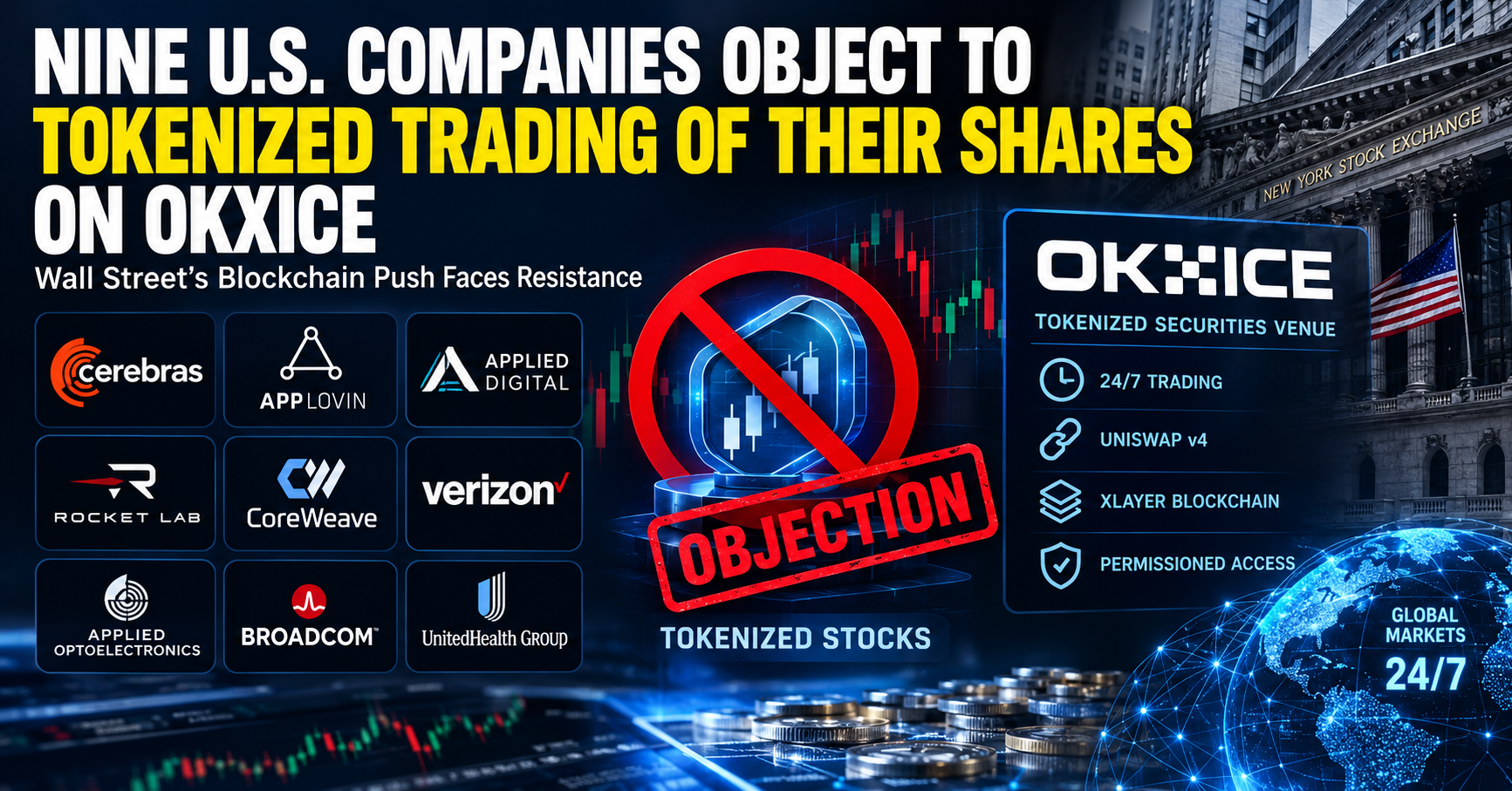
Nine Companies Object to OKXICE Tokenized Stock Trading as Wall Street's Blockchain Push Faces Resistance
Nine US-listed companies have objected to plans by OKXICE to offer tokenized versions of their shares through a proposed blockchain-based trading venue, highlighting the legal, liquidity and investor-protection questions surrounding the growing market for tokenized securities.
According to an OKXICE public notice dated October 15, the companies are Cerebras Systems, AppLovin, Applied Digital, Rocket Lab, CoreWeave, Verizon Communications, Applied Optoelectronics, Broadcom and UnitedHealth Group. Their objections mean their shares cannot be offered through the specific OKXICE venue under the applicable issuer-objection process.
The development presents an early test for a proposed model that seeks to connect traditional US equities with blockchain-based trading infrastructure. OKXICE plans to facilitate secondary-market trading in tokenized US stocks through permissioned liquidity pools using Uniswap v4 technology on XLayer, the blockchain network associated with OKX.
The venture is backed equally by Intercontinental Exchange (ICE), the parent company of the New York Stock Exchange, and OKC USA Holding. Its proposal is part of a wider effort to make US equity markets accessible through digital-asset infrastructure, potentially allowing eligible participants to trade tokenized securities around the clock.
However, the objections show that not every public company is comfortable with having its shares represented by blockchain-based tokens on a third-party platform.
Sources: The Block and Barron's.
Which Nine Companies Have Objected to OKXICE?
The October 15 notice identifies nine issuers that have objected to the proposed tokenized trading of their shares on OKXICE.
| Company | Ticker |
|---|---|
| Cerebras Systems | CBRS |
| AppLovin | APP |
| Applied Digital | APLD |
| Rocket Lab | RKLB |
| CoreWeave | CRWV |
| Verizon Communications | VZ |
| Applied Optoelectronics | AAOI |
| Broadcom | AVGO |
| UnitedHealth Group | UNH |
The list spans several industries, including artificial intelligence infrastructure, semiconductors, telecommunications, aerospace, digital infrastructure and healthcare.
Their objections should not be interpreted as a blanket rejection of all tokenization technology. The notices concern the proposed OKXICE venue specifically. They do not automatically prohibit other eligible platforms from pursuing separate tokenization arrangements involving the same companies, subject to the applicable laws and regulatory requirements.
The distinction matters because tokenization can refer to different products and legal structures. A token representing an actual share with associated shareholder rights is not necessarily equivalent to a derivative or synthetic token that simply tracks a stock's price.
The nine objections therefore represent a challenge to this particular listing process, rather than proof that tokenized equities as a category cannot develop.
Source: The Block's report on the issuer objections.
Why Are Companies Pushing Back Against Tokenized Shares?
The objections have arrived as financial institutions and crypto platforms explore ways to move conventional securities onto blockchain infrastructure.
Tokenization could make some financial-market processes more flexible, but it also raises questions about price formation, liquidity, governance and how investors understand the products they are buying.
Concerns About Stock Prices and Liquidity
One of the clearest publicly reported explanations came from Applied Optoelectronics.
According to reporting by The Wall Street Journal, a company spokeswoman said Applied Optoelectronics was concerned about uncertainty surrounding the potential effect of tokenization on its share price, liquidity and volatility. She also indicated that the company did not see a clear benefit for the business or its shareholders that justified those uncertainties at this stage.
Source: The Wall Street Journal.
These concerns reflect a broader market-structure issue.
A tokenized version of a listed stock could trade at a different price from the underlying share if the two markets have different liquidity, trading hours or participant bases. If that difference becomes significant, investors may receive conflicting signals about the value of the same company's equity.
Liquidity is particularly important. A tokenized market with relatively few buyers and sellers may experience wider spreads or sharper price movements than the traditional stock market. Those risks could become more visible outside regular US trading hours, when the underlying stock exchange is closed.
This does not mean price differences are inevitable. It means that the design of the market, the depth of its liquidity pools and the mechanisms linking tokens to underlying shares will be important to its operation.
The Risk of Investors Mistaking Participation for Company Endorsement
Another concern is how investors interpret the presence of a company's shares on a third-party tokenization platform.
A tokenized listing may mention a company's name, ticker or stock price even when the company has not agreed to participate in the arrangement. Some investors could incorrectly assume that the issuer supports, sponsors or directly operates the offering.
That distinction can affect investor understanding, brand reputation and confidence in the product.
The issuer-objection mechanism gives companies a way to prevent their shares from being included on a particular venue under the relevant framework. It also creates a clearer distinction between an issuer-led tokenization initiative and a third-party effort that proceeds without the company's participation.
Questions About Governance and Shareholder Rights
Traditional shareholders may have rights involving dividends, voting and corporate actions, depending on the security and the terms under which they hold it.
Tokenized securities introduce additional questions about how those rights are represented, recorded and exercised through the underlying legal and technical arrangements.
The SEC's September 17, 2026, innovation-exemption framework provides for tokenized securities covered by the framework to retain the same shareholder rights as traditional shares, including dividend and voting rights. However, the practical implementation of those rights depends on the specific product structure and its compliance with applicable conditions.
Investors should therefore examine the legal documentation behind a tokenized security instead of assuming that every token carrying a stock ticker provides direct ownership of the underlying shares.
Source: Reuters on the SEC's tokenized-stock exemption.
What Is OKXICE Planning to Build?
OKXICE is a joint venture between Intercontinental Exchange Holdings and OKC USA Holding, with each holding a 50% ownership interest.
The venture has proposed a Tokenized Securities Venue, or TSV, designed to facilitate secondary-market trading of tokenized US-listed equities. Its public notice describes a permissioned system built around automated market-maker liquidity pools using Uniswap v4 contracts on XLayer.
Rather than relying on a conventional central limit order book, the proposed model uses liquidity pools to facilitate swaps between tokenized securities and approved payment stablecoins.
The notice identifies USDC, USDG and USDT as intended trading pairs for the tokenized stocks.
Access is permissioned. According to descriptions of the proposed venue, participants must complete the required identity and sanctions screening and hold a non-transferable token used to establish eligibility to access the pools.
The system is therefore not designed as an unrestricted market in which any anonymous wallet can automatically trade every tokenized share.
OKXICE has described the proposal as a way to extend access to US equity markets beyond conventional trading hours. However, a proposed 24/7 trading model does not mean the venue has already launched or that all planned stocks are available to trade.
Source: The Block's report on the OKX-ICE venture.
How Does the SEC's Tokenization Framework Work?
The US Securities and Exchange Commission introduced a temporary innovation-exemption framework on September 17, 2026, for qualifying tokenized-securities venues and certain liquidity providers.
The framework provides conditional relief from specified regulatory requirements, including aspects of the rules that would otherwise apply to exchange and dealer registration. It is not an unconditional approval of every tokenization business or product.
A key feature is the issuer-notification process.
Under the framework, a venue must notify a company before offering a third-party tokenized version of its stock and allow the required objection period to run. If the issuer submits a timely objection, the venue cannot offer that company's tokenized shares under the relevant process.
The framework also establishes conditions and limits that qualifying participants must satisfy. The exemption is temporary, with a five-year period specified by the SEC.
For issuers, this creates an opportunity to assess a proposed tokenized listing before it proceeds. For platforms, it establishes a pathway to develop tokenized securities markets while operating within defined regulatory conditions.
Importantly, the exemption should not be described as a blanket SEC endorsement of OKXICE or a guarantee that its planned venue will be commercially successful.
Source: Reuters — US securities regulator rolls out five-year exemption for tokenized stock trading.
Why the 30-Day Objection Period Matters
The objection period is central to understanding why the nine companies can prevent their shares from being offered on the proposed OKXICE venue.
The process gives issuers a defined period to respond after receiving notice of a proposed third-party tokenized listing. A timely objection prevents the relevant venue from proceeding with that stock under the framework.
The rule does not necessarily prevent the same company from participating in tokenization through another compliant arrangement. It also does not mean that silence represents an explicit endorsement by the issuer.
That is an important distinction in a market where companies may be evaluating unfamiliar technical and legal structures.
The objections also demonstrate that tokenization is not simply a matter of placing a stock ticker on a blockchain. Market operators must consider issuer rights, securities regulation, investor disclosures and the practical relationship between a token and the underlying equity.
What Does This Mean for the Future of Tokenized Stocks?
The response from the nine companies highlights the difference between technical innovation and adoption by traditional issuers.
Blockchain technology can support digital representations of securities, but the success of tokenized markets will depend on more than the ability to execute transactions on-chain.
Investors need confidence that tokenized securities have a clear legal structure, that the associated rights can be exercised and that market prices remain meaningful. Issuers may also want assurance that tokenization will not create unnecessary volatility, fragmented liquidity or confusion about their involvement.
For trading platforms, the challenge is to demonstrate that tokenized products offer practical benefits over existing systems. Those benefits could include longer trading hours, more flexible settlement arrangements and integration with digital-asset infrastructure, but the extent of those advantages will depend on implementation and market demand.
The nine objections do not establish that tokenized equities will fail. Instead, they show that issuer participation and market safeguards will be important considerations as the industry develops.
What Happens Next for OKXICE?
OKXICE's proposal remains part of a broader shift toward exploring blockchain-based financial markets. The nine issuer objections remove those companies' shares from the proposed venue under the applicable process, but they do not by themselves establish the final size, timing or commercial prospects of the project.
The venture has indicated that it intends to pursue tokenized trading across a wider group of US-listed companies. The status of individual securities, the final product arrangements and the timing of any launch should be checked against subsequent official notices and disclosures.
For the broader industry, the next milestones will include how platforms satisfy regulatory conditions, how liquidity develops and whether investors and issuers find the resulting products useful.
The market's evolution will depend on whether tokenized securities can combine the accessibility of blockchain infrastructure with the transparency, legal clarity and investor protections expected of established financial markets.
Frequently Asked Questions
1. Which nine companies objected to OKXICE tokenized stock trading?
The companies are Cerebras Systems, AppLovin, Applied Digital, Rocket Lab, CoreWeave, Verizon Communications, Applied Optoelectronics, Broadcom and UnitedHealth Group.
2. What is OKXICE?
OKXICE is a joint venture owned equally by Intercontinental Exchange Holdings, the parent company of the New York Stock Exchange, and OKC USA Holding. It has proposed a permissioned venue for trading tokenized US equities.
3. Does an objection ban a company's shares from every tokenization platform?
No. The objection applies to the relevant venue and process. It does not automatically prohibit separate tokenization arrangements elsewhere, provided they comply with applicable legal and regulatory requirements.
4. Why did Applied Optoelectronics object?
According to reporting by The Wall Street Journal, the company cited uncertainty about the potential effects of tokenization on its stock price, liquidity and volatility, along with a lack of clear benefits that justified those uncertainties.
5. What blockchain technology does OKXICE plan to use?
The proposed venue uses permissioned automated market-maker liquidity pools built with Uniswap v4 contracts on XLayer.
6. Can tokenized stocks trade 24 hours a day?
The proposed OKXICE model is designed for round-the-clock trading. Actual availability depends on the venue's launch, operating conditions, eligible assets and applicable restrictions.
7. Does the SEC exemption mean tokenized stocks are risk-free?
No. The exemption provides conditional regulatory relief for qualifying activities. It does not eliminate market risk, guarantee liquidity or ensure that every tokenized product is suitable for every investor.
About CoinAINews: CoinAINews covers cryptocurrency markets, blockchain technology, digital assets, financial regulation and developments connecting traditional finance with the digital economy.
Disclaimer: This article is for informational purposes only and does not constitute investment, legal or financial advice. Tokenized securities involve market, liquidity, technological and regulatory risks. Readers should consult official filings and applicable product disclosures before making investment decisions.