
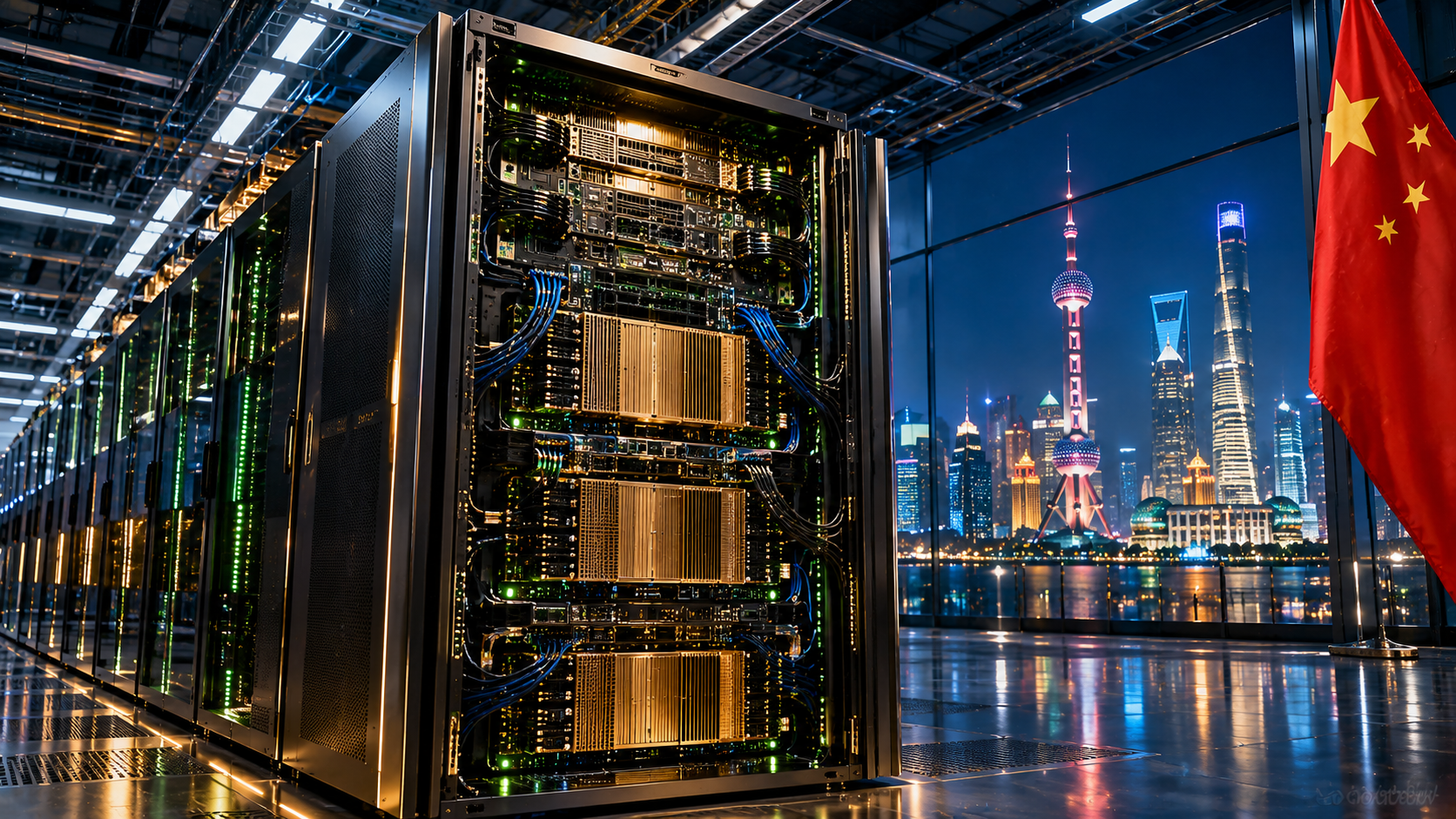
Nvidia's Restricted Blackwell Chips Found in China — A $14 Million Loan Reveals the Trail
A $14 million loan filing has helped uncover something that could raise fresh questions about the global AI chip trade: Nvidia's powerful Blackwell hardware has appeared at a data center in Shanghai, China, despite strict US export restrictions.
The discovery began with a serial number recorded in Chinese financial documents. Bloomberg matched it against Gigabyte's public warranty database and identified the equipment as an Nvidia GB300 NVL72 server rack.
The November 27 report also identified another Blackwell-based system at the same facility. The findings have drawn attention because shipping these systems to China requires a US export licence.
However, how the hardware reached Shanghai remains unclear, and the available evidence does not establish who was responsible for bringing it there.
A $14 Million Loan Exposed the Nvidia Server
The first clue came from Shanghai Shuoyao.
According to Bloomberg, the Chinese company pledged a server rack as collateral to secure a 96 million yuan loan, worth approximately $14 million, from Shanghai Innovation Bank.
A serial number included in the regulatory documents allowed Bloomberg to trace the equipment through Gigabyte's public warranty database.
The result pointed to a GB300 NVL72 rack, one of Nvidia's most powerful AI computing systems. It contains 72 Blackwell Ultra GPUs and 36 Grace CPUs.
A second company, Shanghai Kezhan, also identified a GB200 server at the same data center in documents connected to a separate 90 million yuan loan in late 2025.
Both systems belong to Nvidia's Blackwell generation.
Why the Discovery Matters to the US-China AI Race
Nvidia's Blackwell processors are designed for demanding artificial intelligence workloads, including training and running advanced AI models.
Access to such computing power has become a major issue in the technology competition between Washington and Beijing.
The United States requires an export licence for shipping these advanced Blackwell systems to China. The restrictions are intended to limit China's access to high-end computing technology with potential strategic and military applications.
The appearance of these systems at a Shanghai facility therefore raises questions about how restricted technology moves through international supply chains.
But finding the hardware does not automatically reveal how it arrived. Bloomberg noted that advanced servers can pass through several companies and distribution networks before reaching their final destination.
What Is Megaspeed's Connection?
The Shanghai facility, known as the Yangtze River Delta Project, has links to Singapore-based AI infrastructure company Megaspeed, founded by Alice Huang.
Megaspeed has attracted US scrutiny over concerns about the possible diversion of Nvidia chips to China. The US government recently added the company to its trade blacklist, citing concerns about its potential involvement in chip diversion.
Shanghai Shuoyao confirmed that it provides services to Megaspeed, describing the relationship as ordinary commercial cooperation.
However, Bloomberg explicitly reported that it found no evidence that Megaspeed itself diverted the GB300 hardware identified at the Shanghai facility.
Megaspeed has denied wrongdoing.
The distinction is important: the presence of restricted hardware at a connected facility does not establish that Megaspeed supplied it or violated export regulations.
What Happens Next?
The findings arrive as the US continues tightening controls over advanced semiconductor exports to China.
For Nvidia, the issue highlights the difficulty of tracking high-value AI hardware once it enters international distribution networks.
For policymakers, it raises another challenge: how effectively can export restrictions be enforced when equipment may change hands several times before reaching its destination?
The documents reviewed by Bloomberg establish that Blackwell-based hardware was listed at the Shanghai facility. They do not establish the complete shipping route, the original buyer or whether the specific equipment had received export authorisation.
One serial number and a $14 million loan have opened a much bigger conversation about Nvidia, China and the limits of controlling the global AI chip supply chain.
The Bottom Line
- Shanghai Shuoyao pledged an Nvidia GB300 NVL72 rack as collateral for a 96 million yuan ($14 million) loan.
- Bloomberg identified the rack through its serial number and Gigabyte's public warranty database.
- Shanghai Kezhan separately listed a GB200 server at the same data center.
- The facility has links to Alice Huang's Megaspeed.
- Megaspeed denies wrongdoing, and Bloomberg found no evidence that it diverted the identified GB300 rack.
- How the hardware reached Shanghai remains unclear.
About CoinAINews
CoinAINews Editorial Team covers cryptocurrency, artificial intelligence, blockchain technology, global financial markets, semiconductor developments and the technology shaping the digital economy.
Disclaimer: This article is for informational purposes only and does not constitute financial or investment advice.
Sources
Bloomberg – Nvidia Blackwell Chips Turn Up at China Site Tied to Alice Huang (November 27, 2026)
Bloomberg – Alice Huang-Linked Firm Procured Banned Nvidia Chips in China (November 13, 2026)
Editorial Note: This report distinguishes between the documented presence of Blackwell hardware at the Shanghai facility and the still-unresolved question of how it reached China. No company is described as responsible for an export violation without supporting evidence.