
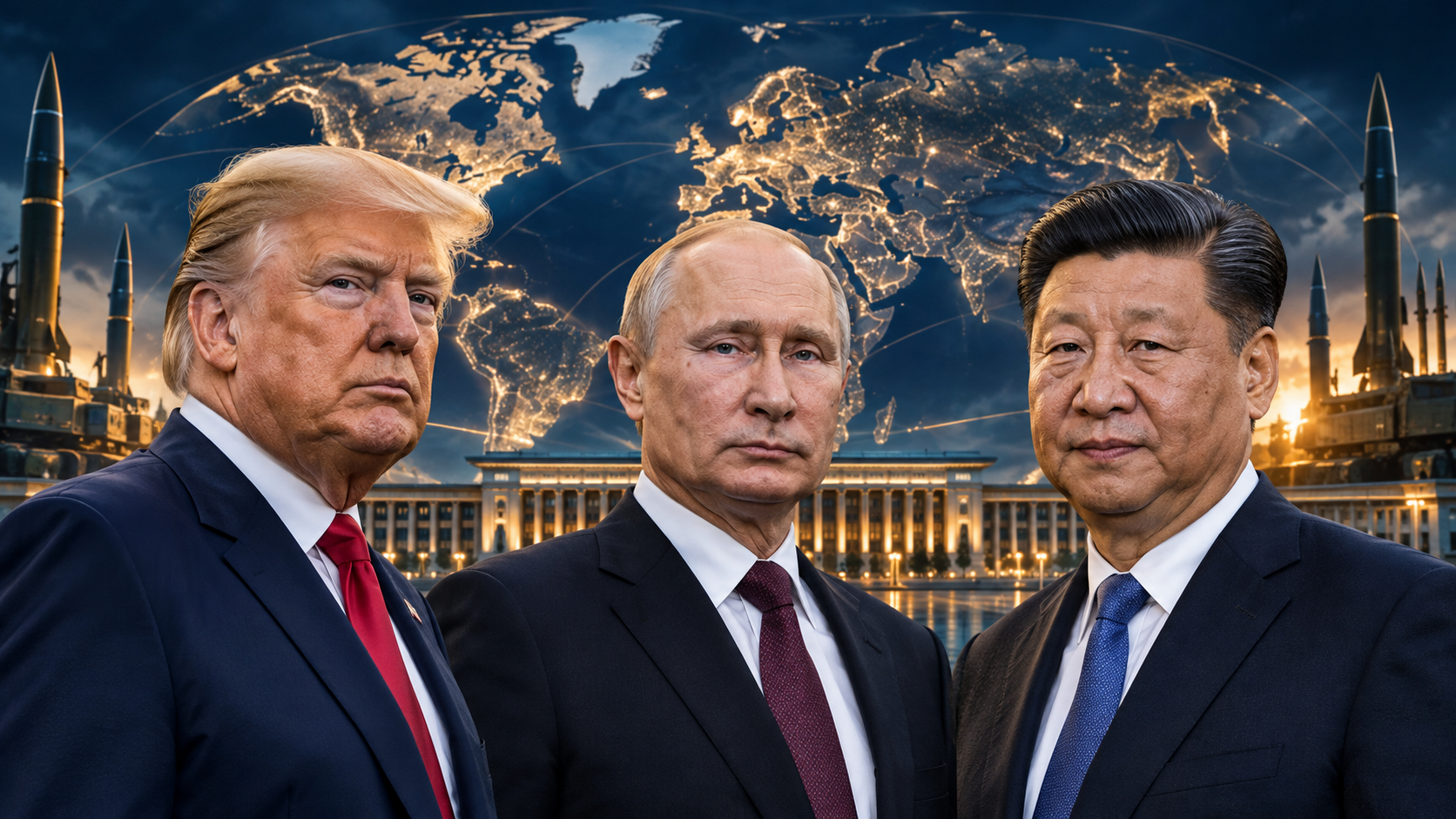
Trump, Putin and Xi Jinping Summit: Nuclear Showdown That Could Change the World
What happens when the presidents of the United States, Russia and China sit at the same table? The answer could influence the future of global security, nuclear weapons and international power politics.
Donald Trump, Vladimir Putin and Xi Jinping are scheduled to hold an unprecedented three-way meeting in Shenzhen, China, on November 19, 2026, on the sidelines of the Asia-Pacific Economic Cooperation (APEC) summit.
But this is not an ordinary diplomatic gathering.
The biggest issue expected to dominate the discussions is nuclear weapons. Trump wants to explore reducing nuclear arsenals worldwide, potentially opening a new chapter in arms-control negotiations involving Washington, Moscow and Beijing.
The meeting has been confirmed by the White House and the Kremlin, while China's Foreign Ministry has also announced the gathering.
The timing makes it particularly significant. The last major nuclear arms-control agreement between Washington and Moscow, the New START treaty, expired in February 2026. Meanwhile, China continues to expand its nuclear capabilities, and the conflict involving the United States, Israel and Iran adds another layer of geopolitical uncertainty.
Three leaders, three nuclear powers and competing national interests are now coming together for a conversation that could have consequences far beyond the meeting room.
Trump, Putin and Xi: Why Is This Meeting So Important?
The November 19 gathering will bring together three leaders whose decisions influence global military security, international trade, energy markets and diplomatic relationships.
However, each president is approaching the meeting with different priorities.
Donald Trump wants to discuss reducing nuclear weapons and potentially establishing a modern arms-control framework that includes China alongside Russia and the United States.
Vladimir Putin wants Russia's strategic position to remain central to international negotiations. Moscow also sees the gathering as an opportunity to strengthen its diplomatic standing and discuss wider international security issues.
Xi Jinping faces a different challenge. China is hosting the meeting, but Beijing has consistently resisted proposals that would place its nuclear arsenal under the same restrictions as those of Washington and Moscow.
The differences between these three positions explain why the summit is attracting international attention.
Even if the leaders do not announce a formal agreement, their discussions could influence future negotiations between the world's biggest military powers.
Nuclear Weapons Are at the Centre of Trump's Agenda
The most important subject expected to dominate the Shenzhen meeting is nuclear arms control.
Trump has made it clear that he wants to discuss reducing nuclear weapons with Putin and Xi.
The White House has described nuclear proliferation as a serious danger and indicated that the president wants to explore ways to reduce global nuclear arsenals.
This proposal comes at a particularly sensitive moment.
For decades, nuclear arms-control agreements helped establish limits and communication channels between Washington and Moscow. However, the expiration of New START has removed the last major bilateral treaty framework limiting the strategic nuclear forces of the two countries.
Without a replacement agreement, uncertainty surrounding future nuclear deployments could increase.
Trump now wants a broader conversation that brings China into the picture.
That is where the negotiations could become difficult.
New START Treaty Has Expired: Why the World Is Concerned
The New Strategic Arms Reduction Treaty, commonly known as New START, was one of the most important nuclear arms-control agreements between the United States and Russia.
The treaty entered into force in February 2011 and was extended in 2021.
Under its central limits, both countries were restricted to:
- 1,550 deployed strategic nuclear warheads.
- 700 deployed intercontinental ballistic missiles, submarine-launched ballistic missiles and nuclear-capable heavy bombers.
- 800 deployed and non-deployed launchers and heavy bombers.
The agreement expired on February 5, 2026.
Its expiration removed the treaty's legally binding limits and associated verification framework, creating uncertainty about the future direction of the two largest nuclear arsenals.
Trump wants a new and modernised agreement rather than simply returning to the previous arrangement.
But there is a major difference between the old agreement and his proposed approach: China would potentially become part of the negotiations.
That could make the next generation of nuclear diplomacy significantly more complicated.
China Has Around 620 Nuclear Warheads: Why Beijing Is Reluctant
China's nuclear arsenal is one of the biggest reasons a new agreement could be difficult to achieve.
According to the Stockholm International Peace Research Institute (SIPRI), China had an estimated 620 nuclear warheads in January 2026.
For comparison, SIPRI estimated the total nuclear inventories of the United States and Russia at approximately 5,042 and 5,420 respectively.
These figures include deployed and stored weapons as well as retired warheads awaiting dismantlement.
The difference is significant.
Beijing argues that its nuclear capabilities are not comparable to those of Washington and Moscow. From China's perspective, accepting identical restrictions could place it at a strategic disadvantage.
China has also been expanding its nuclear capabilities faster than any other country, according to SIPRI's 2026 assessment.
This creates a difficult diplomatic situation.
Washington wants China involved in a broader arms-control framework, while Beijing does not want negotiations to impose restrictions that it considers unfair.
Unless the three governments can find common ground, a comprehensive nuclear agreement could remain out of reach.
Iran War Could Become Another Major Issue at the Summit
Nuclear weapons are not the only issue expected to appear in the discussions.
Trump is also expected to raise the war involving the United States, Israel and Iran with Putin and Xi.
Both Russia and China have important strategic interests in the Middle East.
For Washington, the conflict involves regional security, military operations and the wider challenge of preventing further nuclear-related escalation.
For Moscow and Beijing, developments in Iran could affect regional stability, energy markets and their relationships with countries across the Middle East.
This makes the subject particularly important.
However, the three governments may not share the same approach to resolving the conflict.
Trump wants to advance American diplomatic and security interests, while Putin and Xi have their own strategic calculations.
The meeting could provide an opportunity to discuss possible diplomatic approaches, although no breakthrough or joint position has been announced.
Ukraine War Adds Another Layer of Geopolitical Tension
Another major question surrounding the summit is whether the leaders will discuss the war in Ukraine.
US officials have indicated that Ukraine is not expected to be part of the formal trilateral agenda and that negotiations involving the conflict are being handled through a separate diplomatic channel.
Russia, however, has signalled that it wants to continue discussing the Ukraine war with Washington.
This difference matters.
Putin may see the meeting as an opportunity to strengthen Russia's diplomatic position, while Trump is attempting to keep the nuclear and Iran discussions within a separate framework.
Ukraine and its international partners will also be watching the gathering carefully.
Any suggestion that major powers could discuss European security without Ukraine's direct participation would raise serious political concerns.
For Kyiv, the central issue is that decisions affecting its future should not be made without its involvement.
Is This a New Yalta Moment for the World?
The planned Shenzhen gathering has already triggered comparisons with the historic Yalta Conference of 1945.
At Yalta, US President Franklin D. Roosevelt, British Prime Minister Winston Churchill and Soviet leader Joseph Stalin discussed the international order following World War II.
The comparison is politically sensitive because the conference became associated with decisions that shaped post-war Europe.
The upcoming meeting is different. There is no announced plan to divide territories or redraw international borders.
Nevertheless, the comparison reflects wider concerns about the influence of major powers over international affairs.
Ukraine and Taiwan are particularly important in this context.
Smaller countries will be watching to see whether discussions between Washington, Moscow and Beijing could influence their security interests.
The central question is whether this gathering will strengthen international cooperation or reinforce the idea that the world's biggest powers can shape global outcomes through direct negotiations.
Can Trump, Putin and Xi Reach a Historic Nuclear Agreement?
A comprehensive nuclear agreement is unlikely to emerge from a single meeting.
Any serious arms-control framework would require detailed negotiations covering:
- Nuclear warhead limits and future stockpiles.
- Verification and inspection arrangements.
- Missile and strategic delivery systems.
- Military technology and modern weapons.
- Compliance mechanisms and enforcement.
- Security guarantees and strategic balance.
The three countries would also need to agree on how restrictions should apply to arsenals of very different sizes.
US officials have cautioned against expecting an immediate agreement from the Shenzhen gathering.
Instead, the meeting is being viewed as an opportunity to open discussions and establish a possible diplomatic channel.
That distinction is important.
A successful first conversation could create momentum for future negotiations, but it would not automatically resolve the underlying disagreements.
What the Summit Could Mean for Global Markets and Investors
Although the meeting is primarily about international diplomacy and nuclear security, its consequences could extend into the global economy.
Geopolitical uncertainty can influence oil prices, energy supply expectations, currency markets, defence spending and investor confidence.
Any positive signal regarding the Iran conflict could affect expectations surrounding Middle Eastern energy supplies.
Similarly, progress in US-Russia relations could influence international financial sentiment.
China's position also matters because its relationship with Washington affects global trade, manufacturing and technology supply chains.
For investors, the important factor will be whether the summit produces meaningful diplomatic progress or simply another round of competing political statements.
Markets may respond to announcements and changing geopolitical expectations, but no specific market outcome can be guaranteed.
November 19 Could Become a Defining Moment in Global Politics
The Shenzhen summit represents something that goes beyond an ordinary diplomatic meeting.
For the first time, Donald Trump, Vladimir Putin and Xi Jinping are expected to sit together in a formal trilateral gathering.
Each leader has a different vision of international security, but all three recognise the importance of maintaining strategic influence.
Trump wants to open a new nuclear arms-control conversation.
Putin wants Russia to retain its position as a major global power.
Xi wants China to protect its strategic interests while avoiding restrictions that Beijing considers unfair.
Whether these competing priorities can produce meaningful cooperation remains uncertain.
But the meeting itself could become an important moment in the future of international diplomacy.
The decisions made after November 19 may matter just as much as the discussions taking place inside the room.
The Bottom Line
Donald Trump, Vladimir Putin and Xi Jinping are preparing for a historic three-way meeting in Shenzhen on November 19, 2026.
Nuclear weapons, the expiration of the New START treaty and the conflict involving Iran are expected to dominate discussions.
China's growing nuclear arsenal and its reluctance to accept restrictions alongside the United States and Russia could make negotiations particularly difficult.
The summit is not expected to produce an immediate nuclear agreement, but it could open a new diplomatic channel between the world's three major nuclear powers.
The world is now watching one central question: Can Washington, Moscow and Beijing find common ground before the next phase of the global nuclear arms race becomes even more dangerous?
About CoinAINews
CoinAINews Editorial Team covers cryptocurrency regulation, blockchain technology, digital asset markets, traditional finance, global economic developments and major geopolitical events shaping the world.
Disclaimer: This article is for informational and educational purposes only. It does not constitute financial, investment or political advice. Nuclear arsenal figures are estimates based on publicly available research. Future diplomatic agreements and geopolitical developments remain uncertain.